
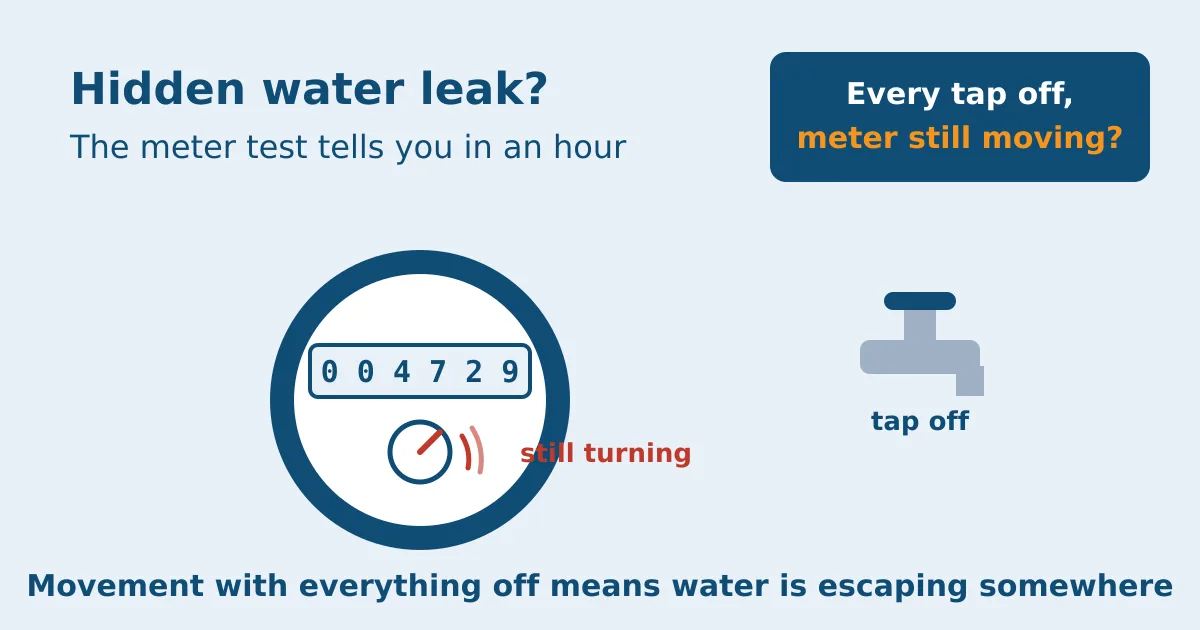
How can you tell if you have a water leak? The most reliable check is the water meter test: turn off every tap and water-using appliance, write down the meter reading, use no water for 30 to 60 minutes, then read it again. If the digits or the small low-flow dial have moved, something between the meter and your taps is losing water. Without a meter, you rely on secondary evidence: an unexplained damp patch, a warm area of floor, boiler pressure that keeps falling, the sound of water at night, or a bill that has climbed without explanation.
One sign on its own proves little; a positive meter test, or two or three signs together, means the leak is real and worth acting on. Here is how to run the test properly, what each warning sign tells you, and how a professional pinpoints the source without tearing your home apart.
The Water Meter Test: an Answer in Under an Hour
If your home is metered, you own a leak detector already. The test costs nothing and settles what guesswork cannot.
- Find the meter. External meters sit under a small cover in the footpath, driveway or front garden near the boundary. Internal meters are typically under the kitchen sink beside the inside stop tap.
- Stop all water use. Close every tap; check the washing machine, dishwasher, toilets and any softener or irrigation are idle. Leave the stop tap open for this stage.
- Record the reading. Photograph the dial face, including the low-flow indicator: the small wheel, disc or triangle most modern meters carry, which turns with even a trickle too slight to register on the digits.
- Wait without using any water. Thames Water’s leak-checking guidance uses a 30-minute window; an hour gives a slow leak more chance to show itself.
- Read it again. Identical readings and a still spinner mean your pipework held tight. Any movement means water left the system while nothing should have been running.
Narrowing It Down with the Stop Tap
A second pass tells you roughly where the leak lives, provided your meter sits outside at the boundary. Close the inside stop tap fully and repeat the wait-and-reread step. Movement with the stop tap shut means the loss is on the buried supply pipe between the boundary and the house; a meter that now holds still points to the internal plumbing or heating pipework beyond the stop tap. An internal meter cannot make this distinction: it sits downstream of the buried run, so a supply pipe leak never passes through it at all, and testing that pipe is a job for the water company’s external stop valve.
One impostor to eliminate first: a toilet valve letting water slip silently down the back of the pan moves the meter exactly like a hidden leak, and Thames Water estimates a constantly flowing leaky loo can pass up to 8,000 litres a day. Dry the back of the pan, lay a fresh sheet of toilet paper against it and leave it overnight; wet or torn paper convicts the toilet, not your pipes.
No Meter? Read the Signs Instead
Unmetered homes have to work from evidence instead, and where it shows up matters as much as what it is.
| Sign | What it usually points to |
|---|---|
| Damp patch, stain or lifting paint | Water tracking from pipework behind the surface, often not directly behind the mark |
| Warm area on a solid floor | Hot water or heating pipe leaking within the floor |
| Boiler pressure that keeps dropping | Water escaping from the sealed heating circuit |
| Musty smell or new mould growth | Persistent hidden moisture feeding spores |
| Faint running or hissing sound at night | Mains water forcing its way out while the house is silent |
| Lush stripe of grass or permanently soggy ground | Buried supply or heating pipe leaking outside |
| Unexplained jump in a metered bill | Continuous water loss over the billing period |
Two of these deserve extra weight. A warm floor patch is one of the stronger indicators, since little apart from a hot pipe below can produce it; a patch that is new, spreading or hotter than it used to be points to a leak rather than a normal pipe run. And a falling heating pressure gauge is a measurement, not an impression. Rule out the innocent explanations first: recently bled radiators drop the pressure too, and a tired expansion vessel can push water out through the boiler’s small copper discharge pipe outside, so glance at that pipe for drips. If neither applies and no radiator valve or visible joint is weeping, the circuit is losing water somewhere out of sight.
The Two Reasons Leaks Stay Invisible
Building practice buried a great deal of pipework where no one can inspect it: cast into solid ground floors and screed, chased into walls behind tiling, or running underground from boundary to kitchen. Many local homes from Bracknell’s New Town decades carry exactly this layout, as our guide to 1960s housing and its plumbing explains, and decades of hard water do ageing pipework no favours either.
The second reason is stranger: water refuses to stay where it escapes. A weep inside a floor void follows gravity and absorbency rather than logic, soaking whatever the structure carries it into and surfacing wherever it finds a way out, often a room or more from the fault. Chasing the damp patch is the classic wasted effort; the mark records where the water finished its journey, not where it began.
What to Do Right Now
If your test came back positive or the signs are stacking up, three things are worth doing today:
- Learn your stop tap. Confirm where it is and that it actually turns. It is the single control that matters if a slow leak ever becomes a fast one.
- Decide whether to switch off. A slow, stable leak can usually stay on while a survey is arranged; shut the stop tap overnight if the loss is on the internal side and you want to limit damage in the meantime.
- Know what counts as an emergency. Water coming through a ceiling, a leak near electrics, or loss you cannot stop at the stop tap needs an emergency plumber rather than a diary slot. TrueFlow answers around the clock, with a 60-minute response target and emergency call-outs from £120 including VAT.
Instruments First, Opening Up Last
The old approach to a hidden leak was to open the building on suspicion: lift boards, break tiles, dig, and hope. Professional leak detection replaces that with instruments, so the property stays intact while the search happens.
- Acoustic listening turns the leak’s own sound against it. Water leaving a pipe under mains pressure has a recognisable signature, and sensitive ground microphones pick it up through solid floors.
- Thermal imaging shows warmth where warmth has no business being: a leaking hot or heating pipe paints its outline on the surface above, visible to the camera long before a hand could feel it.
- Tracer gas handles the quietest failures. A harmless hydrogen-nitrogen mix is introduced into the drained pipework; being lighter than air, it finds the same hole the water did, and a detector swept over the surface flags the point where it comes up.
- Moisture mapping takes readings point by point, so instead of one damp patch you get a gradient, and the wettest end of a gradient is where the story starts.
The evidence from the different instruments narrows to a single point, and only that point is opened for the repair. You also get a documented survey you can hand to your insurer.
Whose Pipe, Whose Bill, and What About Insurance?
Responsibility follows the boundary: the underground supply pipe from there into your home generally belongs to the homeowner, while the water company maintains the main and the connection up to it, as the Consumer Council for Water explains. Before funding a supply pipe repair yourself, though, CCW advises asking your water company about one-off assistance with supply pipe leaks and a leakage allowance crediting back the estimated lost water. On the insurance side, look up trace-and-access cover in your buildings policy. It will not fund the pipe repair itself; it exists to cover the search and to put right what the search opened, and limits vary policy to policy.
As for TrueFlow’s side of the cost: leak detection is quoted individually, because a search can span one bathroom or a whole buried supply run, and no two are alike. The quote is free, the exact price is agreed before any work starts, and repairs carry a 6-month guarantee. Our pricing page lists the fixed prices we publish for drainage work.
FAQ
Does a moving water meter always mean a hidden leak?
No. Anything quietly drawing water during the test will move it: a toilet valve trickling into the pan, an appliance mid-cycle, a softener regenerating, a garden tap left cracked open. Rule those out and repeat the test. A meter that still creeps with every outlet genuinely off is recording real loss, and the stop tap variation then shows which side of the house it sits on.
How long can a hidden water leak go unnoticed?
Months is common, and the smallest weeps can run for years. A pinhole under a solid floor produces no drip to hear and nothing to stain at first; it simply feeds moisture into the structure until a smell, a warm patch or a rising bill finally gives it away. That built-in delay is why a positive meter test deserves prompt attention even when everything still looks dry.
How much does professional leak detection cost?
TrueFlow quotes every leak detection survey individually rather than publishing a standard price, because the search can range from a single bathroom to an entire buried supply run. The quote itself is free, and the exact price is agreed with you before any work begins. If your buildings policy carries trace-and-access cover, part of the search cost may fall to your insurer rather than to you, so read your policy before booking.
Where is my inside stop tap?
Under the kitchen sink is the most common spot, but airing cupboards, downstairs toilets, under-stairs cupboards and garages are all regulars; it sits low down, wherever the mains pipe enters the house. Look for a brass valve with a tap-style head on the incoming pipe. Find yours before you need it, and turn it off and on every six months so it never seizes at the wrong moment.
Turn a Suspicion Into a Pinpointed Repair
If the meter moved, the hard part is over: you know the leak exists, and everything after that is location. TrueFlow traces hidden leaks to a marked point before anything is opened, so the repair disturbs centimetres rather than rooms. Quotes are free, and the line is answered 24 hours a day: 0808 175 7440.