
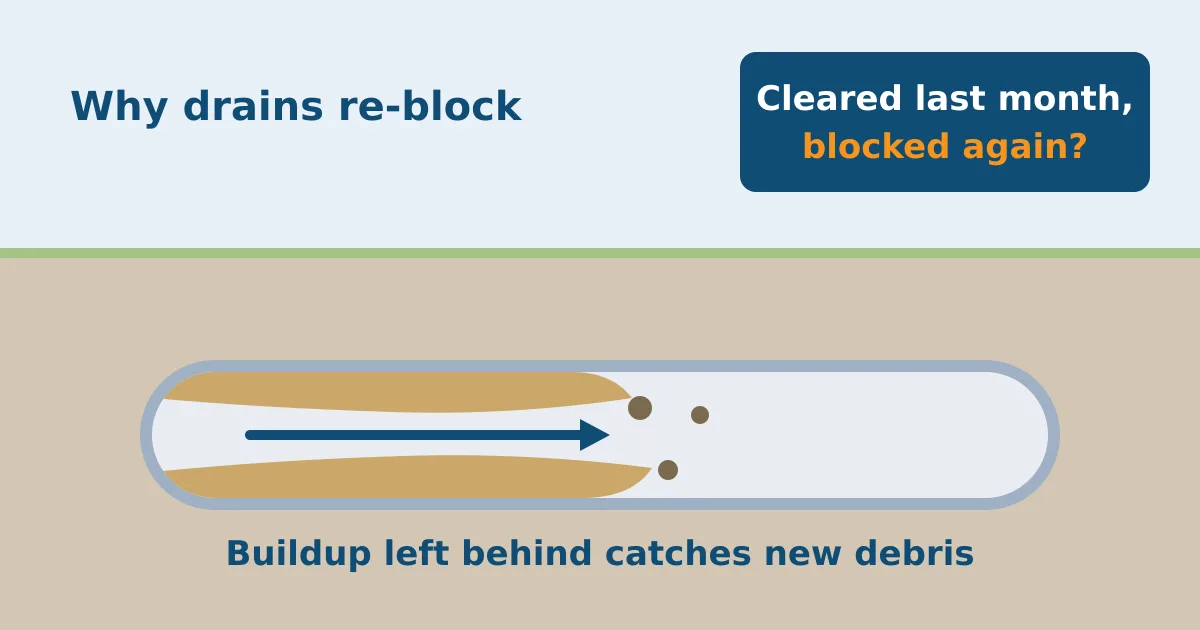
Why does my drain keep blocking? A drain that keeps blocking has an underlying cause that was never removed. The usual suspects are a part-cleared plug of fat or wipes left in the pipe, grease or limescale steadily narrowing the bore, tree roots regrowing through a joint, or a structural fault such as a displaced joint or a sagged section that collects debris. Clearing the blockage restores flow for a few weeks or months. Only removing the cause stops the cycle.
One blockage can be written off as chance. The same drain backing up every few months is a pattern. Here are the seven causes drainage engineers see again and again.
Recurring Blockage Causes at a Glance
| Cause | Typical pattern | Lasting fix |
|---|---|---|
| Part-cleared blockage | Re-blocks within weeks of “clearing” | Jet the whole pipe clean |
| Fat, oil and grease | Kitchen drain, slowly worsening | Jetting, then change disposal habits |
| Limescale | Older pipes in hard-water areas | Descaling jet, address the hard water |
| Tree roots | Same spot, returns within months | Cut roots, then seal the entry point |
| Structural fault | Blocks however careful you are | CCTV survey, then targeted repair |
| Wipes and sanitary items | Toilet line, sudden full blockages | Bin them; never flush |
| Shared sewer problem | Neighbours affected too | Water company clears it, free |
1. The Last Blockage Was Pushed Through, Not Removed
This is the most common reason a drain re-blocks quickly. A plunger or a set of drain rods forces a passage through the middle of the obstruction. Water flows again and the job looks done, but a collar of compacted fat, wipes or scale is left lining the pipe around that passage. It catches the next batch of debris, and within weeks the drain is blocked in exactly the same place.
High-pressure water jetting works differently: it washes the whole ring of leftover material off the pipe and flushes it away, leaving nothing for new debris to build on. That is why a jetted drain stays clear far longer than a rodded one.
2. Fat, Oil and Grease Keep Rebuilding
Kitchen drains have a built-in re-blocking mechanism: cooking fat. It goes down the plughole warm and liquid, then cools and solidifies on the pipe walls a few metres along. Each wash-up adds another film, the bore narrows, and eventually food scraps bridge the gap. Boiling water only shifts the fat further along the pipe.
If your kitchen drain blocks every few months, the fix is a proper jet-clean to strip the accumulated grease, then a change of habit: fat into a container and the bin, pans wiped before washing, a strainer in the sink.
3. Hard Water Is Narrowing the Pipe
Much of the water supplied around here is drawn from the chalk beneath the Thames Valley, which makes it hard, and Bracknell’s supply sits firmly in the hard band. Our hard water in Bracknell guide covers the full effects; the short version for drains is that scale builds up inside pipes the same way it furs a kettle.
A scaled pipe has a rougher, narrower bore, and rough surfaces catch grease, hair and debris far more readily than smooth ones. Descaling jets remove it, though in a hard-water area some rebuild over the years is inevitable.
4. Tree Roots Grow Back
Roots are drawn to the moisture inside a drain and get in through the smallest gap, usually a joint in older clay pipework, then thicken into a mesh of fine roots that sieves paper and waste out of the flow until the pipe blocks.
The part that catches homeowners out: cutting the roots clears the drain, but they regrow through the same entry point, often within a year. If there are mature trees or hedges near the drain, that is likely the rhythm you are seeing. The lasting fix is to cut the roots and then seal the entry point, usually with a patch liner fitted from inside the pipe.
5. The Pipe Itself Is Faulty
Some drains re-block however carefully the household behaves, and that points to the pipe rather than what goes down it. The usual structural culprits:
- Displaced or open joints. Ground movement pulls pipe sections apart, leaving a ledge or gap that snags solids.
- A bellied (sagged) section. Part of the pipe drops, creating a dip of standing water where solids settle instead of flowing through.
- Poor gradient. A drain laid with too little fall never achieves self-cleansing flow, so silt settles along its length.
- Partial collapse. A cracked or deformed pipe restricts the bore and only gets worse.
No amount of clearing fixes these: the defect starts re-collecting debris the moment the engineer leaves.
6. The Wrong Things Are Still Going Down
Wet wipes are the biggest offender: “flushable” means a wipe will leave the toilet pan, not that it breaks down in the drain. When Water UK dissected sewer blockages for its national study, wipes made up around 93% of the material in the blockages it opened up, most of them wipes never designed to be flushed, and the UK sees roughly 300,000 sewer blockages a year. Sanitary products and cotton buds behave the same way: they lodge against any rough spot or fitting, and everything after them piles up.
If a toilet drain blocks repeatedly, an honest audit of what gets flushed is often decisive: only the three Ps (pee, poo, paper) should go down the loo.
7. It Might Not Be Your Drain at All
If the blockage sits in a pipe shared with a neighbour, or in the section beyond your property boundary, it has been the water company’s responsibility since October 2011, and they must clear it at no cost to you. Across our patch that means Thames Water, who handle sewerage even where another company supplies the drinking water. A shared sewer with a recurring fault will keep blocking until the company repairs it; paying privately to clear it each time is money wasted.
Before booking anyone, our blocked drain responsibility guide walks through how to tell whose pipe is actually blocked.
Find the Cause: A CCTV Survey
Every cause above looks identical from the surface: a drain that keeps blocking. A CCTV drain survey is how you tell them apart. A camera travels the pipe and shows exactly what is there: the ring of grease left by past clearances, the root mass at a joint, the standing water in a bellied section. And because the camera carries a locator beacon, the engineer can mark on the ground above exactly where the fault sits and how deep it is.
Surveys start from £120 including VAT. Where a drain is too congested to inspect, we jet it first and run the camera on the same visit, from £220 for both. Full survey pricing is covered in our CCTV drain survey cost guide.
Jetting or Rodding for a Drain That Keeps Blocking?
For a first-time, soft blockage, drain rodding from £80 is usually sufficient. For a recurring blockage, high-pressure jetting from £150 (up to 4000psi) is the better tool, because it removes the accumulated material rather than piercing it.
The honest caveat: jetting cannot fix a structural fault. If a survey shows a bellied or collapsed section, jetting buys time between blockages, but only a repair breaks the cycle. All our prices, including emergency call-outs from £120, are listed on our pricing page, and the exact price is agreed before any work starts.
FAQ
Is it normal for a drain to block every few months?
No. A well-laid drain in a household that keeps fat and wipes out of it should run for years without trouble. If the same drain blocks more than about once a year, something is wrong in the pipe: residual buildup, scale, root ingress or a structural defect. Treat repeat blockages as a symptom worth investigating.
Will jetting stop my drain blocking again?
If the cause is accumulated fat, scale, silt or a part-cleared old blockage, yes: a jetted pipe is left clean rather than merely passable, so recurrence is far less likely than after rodding. If the cause is structural, such as a sagged section or displaced joint, jetting only resets the clock. A CCTV survey after jetting confirms which situation you are in.
Can tree roots in a drain be fixed without digging?
Usually, yes. The roots are first cut out with jetting or mechanical cutting heads, then the entry point is sealed with a resin patch liner installed from inside the pipe, with no excavation. Digging is only needed where the joint is badly displaced or the pipe has deformed. Left unsealed, roots typically regrow through the same gap within a year or so.
Are flushable wipes safe to flush?
No. The label means a wipe will clear the toilet pan, not that it breaks down in the drain like paper does. Water UK’s national blockage study found wipes made up around 93% of the material causing the sewer blockages it examined. In your own pipework they snag on joints, scale and grease, so binning every wipe is the cheapest drain maintenance there is.
Need Help With a Drain That Keeps Blocking?
TrueFlow is based in Bracknell and serves Wokingham, Reading, Windsor, Ascot, Maidenhead, Slough, Camberley, Crowthorne, Sandhurst and the surrounding Berkshire areas: 24/7, 365 days a year, with a 60-minute response target for emergencies. Every job is fully insured, guaranteed for 6 months and priced exactly before work starts.
Call 0808 175 7440 and tell us how often it blocks: that one detail changes the right approach.