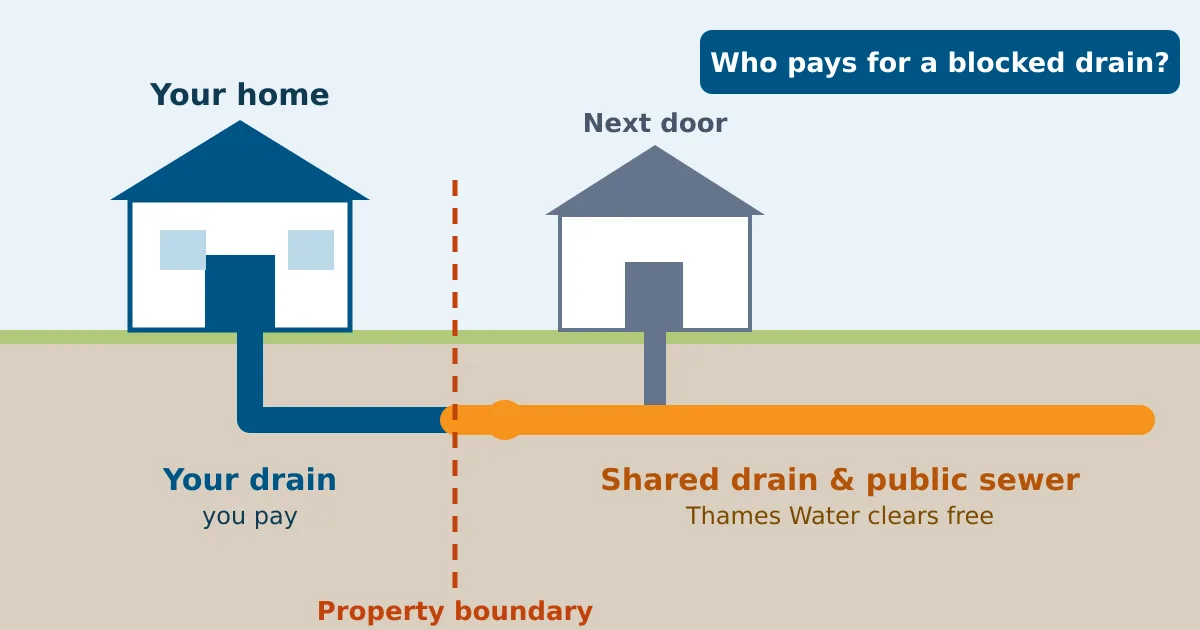
Who is responsible for a blocked drain? You are responsible for drains that serve only your property and sit within your property boundary. Thames Water (or your local water company) is responsible for lateral drains (the section beyond your boundary) and for sewers (pipes shared with other properties), even where they run under your garden. This has been the rule in England and Wales since October 2011, and it means many blockages people pay to clear are actually the water company’s job to fix for free.
Before you book a drainage engineer, or accept a bill, it’s worth two minutes to work out whose pipe is actually blocked. This guide explains the rules, the exceptions, and how to tell the difference.
The three types of pipe (and who owns each)
Drainage law splits underground pipework into three categories:
| Pipe type | What it is | Who’s responsible |
|---|---|---|
| Drain | Serves only your property, within your boundary | You (the homeowner) |
| Lateral drain | The continuation of your drain beyond your property boundary | Thames Water |
| Sewer | Any pipe shared by two or more properties | Thames Water |
The key change came on 1 October 2011, when most private sewers and lateral drains in England and Wales transferred to the water and sewerage companies. Before then, groups of neighbours could be jointly liable for a shared pipe running under all their gardens, with all the arguments that caused. Now, the moment a pipe serves more than one property or crosses your boundary, it’s the water company’s problem.
When Thames Water fixes it for free
If you’re in Bracknell, Wokingham, Ascot or anywhere else in the Thames Water sewerage area, Thames Water must clear blockages in:
- Public sewers, including shared pipes that run under private gardens
- Lateral drains: your pipe once it passes your property boundary, typically under the pavement or road
There’s no call-out charge for this: it’s covered by your sewerage bill. If several houses on your street have gurgling toilets or slow drains at the same time, that’s a classic sign of a public sewer blockage, and your first call should be Thames Water on 0800 316 9800, not a private drainage company.
One caveat: if Thames Water investigates and finds the blockage is in your private section, they’ll leave it with you to resolve. That’s where a professional drain unblocking service comes in.
When it’s your responsibility
You’ll need to arrange (and pay for) clearance when the blockage is in:
- A drain serving only your home, within your boundary: kitchen gullies, bathroom stacks, the pipe run to your boundary
- Private systems not connected to the public network: septic tanks, cesspits and their pipework
- Fittings inside the house: blocked toilets, sinks, baths and internal waste pipes
Typical costs for private clearance run from £80 for a simple blockage to £300+ where jetting is needed. Our drain unblocking price guide breaks down what you should expect to pay in 2026.
What about neighbours, landlords and the council?
Shared drains with a neighbour: if the pipe serves both properties, it’s legally a sewer: Thames Water’s responsibility, regardless of whose garden it sits under. You don’t need your neighbour’s permission to report it, and neither of you should be paying privately.
Rented property: responsibility for drains and pipework sits with the landlord under section 11 of the Landlord and Tenant Act 1985. Tenants should report the problem to their landlord or agent. The exception is blockages the tenant caused (wet wipes, fat, or a toy down the toilet), where the landlord may pass on the cost.
Roads and pavements: roadside gullies and highway drains belong to the local highway authority (Bracknell Forest Council for Bracknell itself), not Thames Water. Report flooded road drains to the council.
How to tell where the blockage is
A few quick checks narrow it down before you call anyone:
- Is it just one fixture? A single slow sink points to a local blockage in the trap or waste pipe, usually a DIY fix.
- Is it just your property? If every drain in your house is struggling but next door is fine, the blockage is probably in your private drain.
- Are neighbours affected too? Multiple properties with problems means a shared sewer: call Thames Water.
- Check your inspection chambers. Lift the manhole cover nearest your house (carefully). If it’s full of water, the blockage is downstream of that point; if it’s dry, the problem is upstream, between the chamber and your house.
If it’s still unclear, or the blockage keeps returning, a CCTV drain survey will locate the problem precisely and show which side of the boundary it sits on. That evidence also matters if you need to prove to Thames Water that the fault is in their section.
Why blockages keep coming back
Repeat blockages in the same spot usually mean an underlying defect rather than bad luck: root ingress, a displaced joint, scale buildup from Bracknell’s very hard water, or a collapsed section of older clay pipe. Clearing the blockage treats the symptom; a survey and repair fixes the cause. If the defect is in a lateral drain or sewer, Thames Water carries the cost of the repair too.
Frequently asked questions
Do I have to pay if the blocked drain is shared with my neighbour?
No. A pipe serving two or more properties is a sewer, and sewers are Thames Water’s responsibility, even where they run under private land. Report it to Thames Water rather than splitting a private bill with your neighbour.
Does Thames Water charge to unblock drains?
Thames Water clears blockages in public sewers and lateral drains free of charge: it’s covered by your sewerage bill. They won’t clear blockages in your private drain, and if they attend and find the fault is on your side of the boundary, you’ll need to arrange clearance yourself.
Who is responsible for blocked drains in a rented house?
The landlord, under section 11 of the Landlord and Tenant Act 1985, which covers drains, gutters and external pipes. Tenants should report problems promptly. If the tenant caused the blockage (wipes, fat, or foreign objects), the landlord can reasonably pass on the clearance cost.
How do I find out where my property boundary is for drainage purposes?
Your title plan (available from HM Land Registry for £7) shows the legal boundary. As a rule of thumb, responsibility usually ends where your drain leaves your land, often at the back edge of the pavement. A CCTV survey can measure exactly where a blockage sits relative to that line.
My drain is blocked right now — who do I call first?
If neighbours are affected too, call Thames Water first (0800 316 9800). The fix may be free. If it’s only your property, call a local drainage company. TrueFlow covers Bracknell and the surrounding areas 24/7 on 0808 175 7440, and we’ll tell you honestly if the problem is one Thames Water should be fixing instead.