
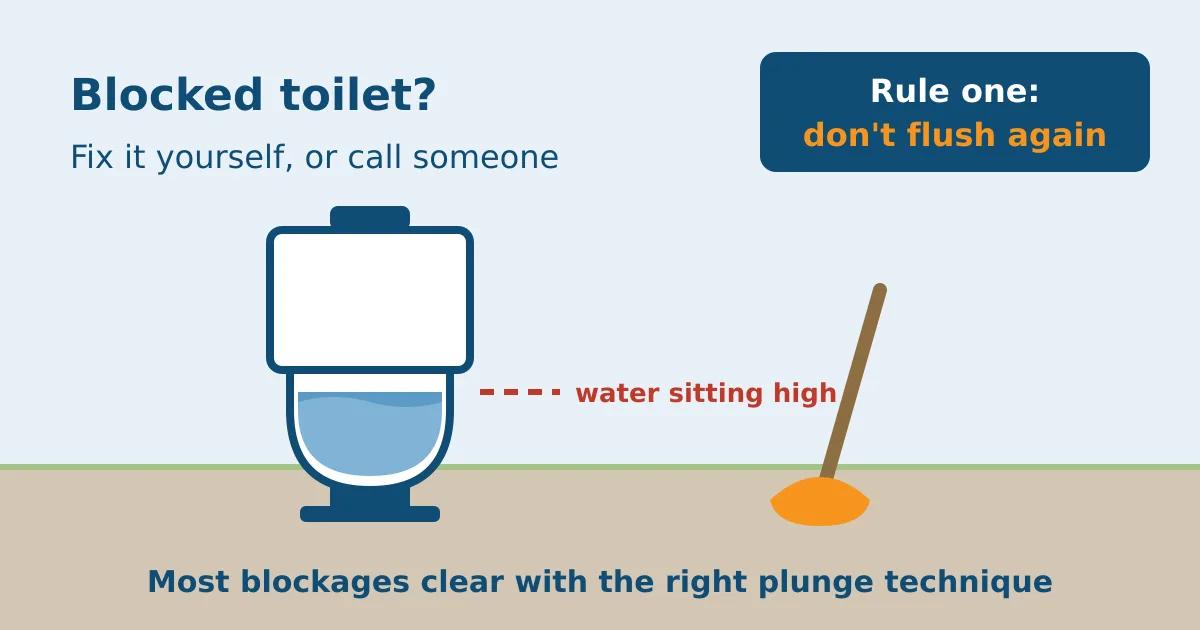
How do you unblock a toilet? Stop flushing, let the bowl level drop for ten minutes, then work a flange plunger over the outlet with slow pushes and sharp pulls until the water drains. Without a plunger, half a bowl of hot water, well short of boiling, with a squeeze of washing-up liquid will soften a paper clog, and a toilet auger will hook out anything tougher. If water also rises in the bath or shower, or the toilet blocks again within days, the problem is in the drain rather than the pan and needs a professional.
Most blocked toilets are a ten-minute fix; a minority are the first symptom of a blocked drain, which no plunger will cure. Here is each method in the order worth trying, and the signs that mean it is time to pick up the phone.
First: Stop the Water Rising
If the bowl is filling towards the rim, deal with the water before the blockage.
- Do not flush again. The cistern will happily send another six litres into a bowl that cannot empty; that is the difference between a blockage and a mopping job.
- Stop the cistern refilling. Lift the lid and press the drop valve shut, or hold the float up; older siphon cisterns have no valve to press, so the float is the trick there. An isolation valve on the small supply pipe, turned a quarter turn, stops the refill entirely.
- Lower the bowl level. Bail water into a bucket with an old jug until the bowl is half full, so plunging cannot splash it over the rim.
- Protect the floor. Old towels around the base, rubber gloves on. A partial blockage often drains slowly by itself while you wait.
Method 1: Plunge It Properly
Most failed plunging comes down to the wrong plunger or the wrong technique. Use a flange plunger, the type with a soft rubber sleeve below the cup: a flat-bottomed sink plunger cannot seal against a curved toilet outlet.
- Make sure there is enough water to cover the cup; add some from a jug if needed.
- Fold the flange out and seat it in the outlet so the cup seals all the way round.
- Start with one slow, gentle push to squeeze the trapped air out; ramming it hard splashes the bowl contents back at you.
- Keeping the seal, pump firmly: a steady push, then a sharp pull back. The suction on the upstroke rocks the clog loose in both directions.
- After fifteen to twenty strokes, break the seal. If the water gurgles away, you are through.
- Test with a bucket of water before you trust the flush.
Plunging shifts compacted paper and waste in the trap. It struggles with wedged solid objects, and it cannot reach a blockage beyond the pan.
Method 2: Hot Water and Washing-Up Liquid
For a clog that is mostly toilet paper, heat and lubricant will often do the work while you make a cup of tea.
- Squeeze a generous measure of washing-up liquid into the bowl and let it sink for a few minutes.
- Heat water until hot to the touch but not boiling: boiling water can crack cold porcelain and soften the plastic pipework and rubber seals behind the pan.
- Pour it in from waist height, so it arrives with a little force, until the bowl is half full.
- Wait twenty to thirty minutes, then plunge or repeat if the level has dropped.
This softens and slides paper clogs. It will not dissolve wet wipes or sanitary products, and it does nothing for a solid object.
No Plunger in the House?
Two improvised stand-ins are worth trying before a trip to the shops:
- The bagged mop. Tie a plastic bag tightly over a mop head, push it into the outlet and work it exactly as you would a plunger.
- The plastic bottle. Fill a large drinks bottle with warm water, thumb over the neck, invert it into the outlet and squeeze hard. The jet can push a soft clog through the trap. Expect splashing.
Leave the unwound wire coat hanger in the wardrobe, though. Bare wire gouges the glaze, leaving scratches that stain in ways no amount of scrubbing removes. Reaching into the trap is a job for the next tool.
Method 3: A Toilet Auger
A toilet auger (or closet auger) is a hand-cranked flexible cable inside a rigid tube, with a sleeved elbow that protects the porcelain. DIY stores and online retailers sell them for under £25, and it is the tool to buy if plunging has failed.
- Feed the elbow into the outlet until the rubber guard rests against the pan.
- Crank the handle clockwise while feeding the cable forward until you feel resistance: that is the blockage.
- Keep cranking gently to screw the tip into the clog and pull it out, or break it up so it flushes through.
- Withdraw the cable slowly, wiping it as it comes, then pour a bucketful of water in to check the flow.
An auger retrieves the wedged objects and wipe bundles that defeat a plunger, but it cannot reach a blockage metres downstream in the underground drain.
What Not to Do
- Do not keep flushing “to see if it’s cleared”. Every hopeful flush risks an overflow. Test with a bucket instead.
- Think twice about caustic soda. Dissolving sodium hydroxide releases enough heat to crack a cold pan, and the UK Health Security Agency notes that skin contact with stronger solutions causes pain, burns and ulcers. And if it fails, you are left plunging a bowl of caustic solution, splashes and all.
- Never combine chemical products. Bleach mixed with an acidic unblocker produces chlorine gas; even the minor exposures typical of mixed cleaning products cause burning eyes, coughing and a sore throat, per the UK Health Security Agency. If one chemical is already in the bowl, do not add a second, and ventilate the room.
Which Fix for Which Blockage?
| Method | Time | Clears | Won’t clear |
|---|---|---|---|
| Flange plunger | 10 min | Paper and waste in the trap | Wedged objects, drain blockages |
| Hot water + washing-up liquid | 30 min | Soft paper-only clogs | Wipes, sanitary items, objects |
| Bottle / bagged mop | 10 min | Soft clogs near the outlet | Anything compacted or deep |
| Toilet auger | 20 min | Objects and wipes in or just past the trap | Blockages metres down the drain |
| Professional clearance | Same day | Everything above, plus the drain itself | N/A |
When to Stop DIY and Call Someone
Some symptoms mean the obstruction is in the drain the toilet empties into, not the pan, and no pan-level method will fix them:
- Water appearing elsewhere when you flush. A shower tray, bath or downstairs plughole that fills or bubbles as the toilet struggles means the soil pipe or underground drain is obstructed.
- Gurgling from other fixtures, as air is dragged through their traps by a blockage downstream of where they join.
- A sewage smell indoors or at outside drain covers, or an inspection chamber standing full of water.
- The blockage keeps returning. Re-blocking every few weeks points to scale, an obstruction left in the pipe, or a defect further down: our guide to why drains keep blocking covers the causes, wipes included. Even “flushable” ones belong in the bin.
Two more situations justify a call even when DIY might eventually work. If it is the only toilet in the house, a same-day fix stops being a luxury; that is what an emergency plumbing service is for. And if neighbours have trouble at the same time, the blockage is probably in a shared sewer, which the water company must clear for free: check our blocked drain responsibility guide before paying anyone.
What a Professional Visit Involves and Costs
A drainage engineer first works out whether the blockage is in the pan or the drain. In-pan obstructions come out with professional augers and non-marking tools that protect the glaze. Downstream, the drain is cleared by rodding from £80 or high-pressure water jetting from £150 (up to 4000psi), and a repeat offender can be inspected with a CCTV survey from £120. Emergency call-outs start from £120, and every price is agreed exactly before work begins. The full list is on our pricing page, and our blocked toilets and sinks service explains how a clearance visit runs.
FAQ
How do you unblock a toilet without a plunger?
Start with hot water, short of boiling, and a squeeze of washing-up liquid, left for twenty to thirty minutes; this shifts most paper clogs. Failing that, a mop head sealed inside a plastic bag works as an improvised plunger, or a large bottle of warm water squeezed into the outlet can push a soft clog through the trap. For anything solid, use a toilet auger, never a coat hanger.
Why does the water rise when I flush a blocked toilet?
Each flush releases several litres from the cistern into a bowl whose exit is obstructed, so the water has nowhere to go but up. A full blockage holds the level high; a partial one lets it drain back slowly. Never flush again until a bucket-of-water test shows the bowl emptying at normal speed.
Can bleach unblock a toilet?
No. Bleach is a disinfectant, not a dissolver: it will not break down wipes, compacted paper or objects, so it tends to sit in the bowl above the clog. It is also hazardous, because bleach mixed with an acidic drain product releases toxic chlorine gas. Mechanical methods, a flange plunger or a toilet auger, are safer and far more effective.
When is a blocked toilet an emergency?
Treat it as an emergency if it is the only toilet in the home, if waste water is overflowing or backing up into baths and showers, or if sewage is surfacing indoors or outside. TrueFlow answers 24/7, 365 days a year with a 60-minute response target for emergencies, and emergency call-outs start from £120 including VAT.
Blocked Toilet Still Not Shifting?
If the plunger and auger have both failed, the blockage has almost certainly moved beyond the pan, and shifting it takes the kit a drainage van carries. From our Bracknell base we attend blocked toilets across the surrounding Berkshire towns, fully insured, with a 6-month guarantee and the exact price agreed before any work starts.
Call 0808 175 7440, 24/7.