
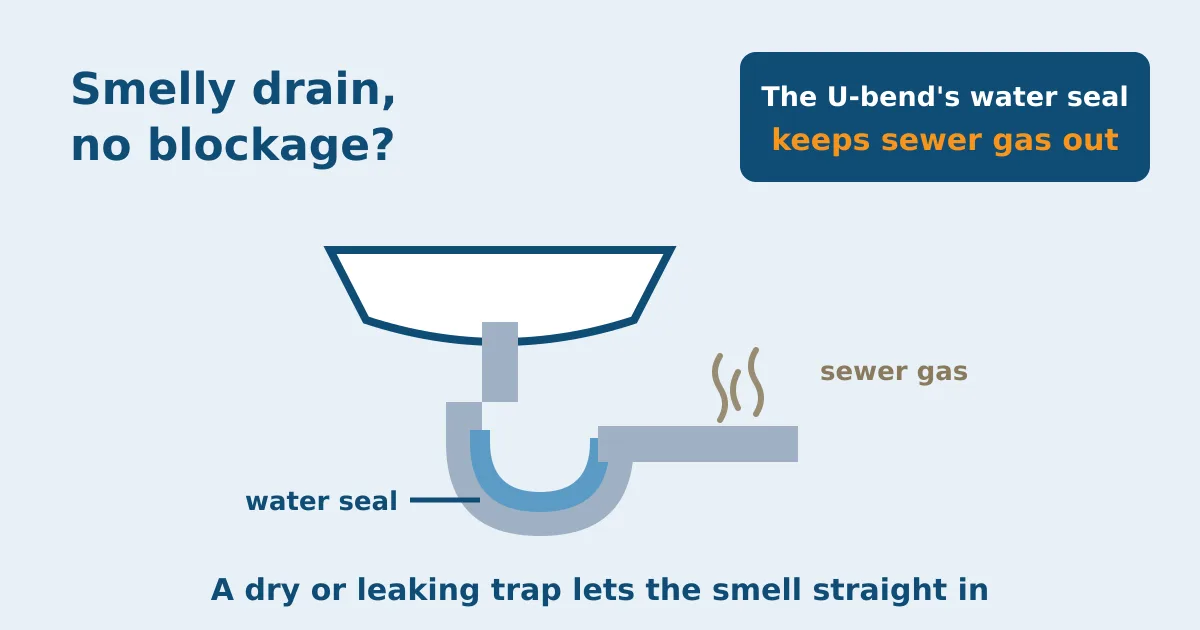
Why does my drain smell? Free flow and a bad smell are separate problems: a drain can empty perfectly and still stink. Nearly every household drain smell comes from one of five sources: a dried-out water trap no longer sealing sewer gas out, bacterial slime in the plughole or standpipe, a badly fitted appliance hose, a perished seal at the toilet or a waste joint, or a blocked soil vent pipe. All can be traced with your nose and a torch, and most cost pennies to put right. The exception is a sewage smell that survives every clean, which can point to a defect in the drain itself.
Smell is a diagnostic tool: where it escapes tells you which seal has failed. Work through the checks below, cheapest first.
The Five-Minute Diagnosis
Before touching a single fitting, narrow the search with four questions:
- Which fixture? Get your nose close to each plughole, the toilet base and any floor gully. One is usually noticeably worse.
- Which room? One bathroom points at a local trap or seal; the whole house points at the soil stack or an underground defect.
- When? After a tap or flush suggests a joint that leaks under flow; hot weather or a holiday suggests evaporation. An en suite nobody uses is a dry trap until proven otherwise.
- What kind of smell?
| Smell | Most likely source | Where to start |
|---|---|---|
| Rotten eggs | Bacterial slime in the plughole, overflow or standpipe | Clean the waste fittings |
| Raw sewage | A lost trap seal, or a failed joint or pan connector | Refill traps, inspect seals |
| Musty or damp | A slow leak or mould under a fixture or floor | Check under the sink and bath |
| Sewage outdoors, near a gully | An underground fault or stagnant chamber | Lift the cover if safe, or book a survey |
The rotten-egg note is hydrogen sulphide, a sewer-associated gas produced by the bacterial breakdown of organic matter. And one smell gets its own rule: if it is gas rather than drains, stop diagnosing and call the National Gas Emergency line on 0800 111 999.
Cause 1: A Trap That Has Dried Out
Under every plughole sits a U-bend (a trap) holding a small plug of water, the only thing separating your room from the air in the sewer. Daily use tops it up; in an unused fixture it slowly evaporates, faster in warm rooms, and once the seal drops, sewer gas has an open corridor into the house. Prime suspects: the spare-room en suite, a downstairs shower nobody likes, a utility-room floor gully.
The test doubles as the fix: pour a jug of water down the suspect plughole and see whether the smell fades over the next day. For traps left unused for months, follow the water with a couple of tablespoons of mineral oil from a chemist; it floats on the seal and slows evaporation right down. Mineral oil, not cooking oil: fats and cooking oils belong nowhere near a drain, as our guide to why drains keep blocking explains.
Cause 2: Biofilm in the Plughole, Overflow and Standpipe
If the smelly fixture is used every day, the trap seal is intact and the smell is coming from above it: a film of hair, soap residue and food waste coating the plughole and the first stretch of pipe. Bacteria in that film generate the rotten-egg odour, and because the coating is thin, water still drains at full speed. This is the classic “sink smells but nothing is blocked” scenario.
Two spots get missed: the overflow slot near a basin’s rim, which connects to a hidden channel that never gets rinsed, and the washing machine standpipe, where detergent residue and lint fester in a warm cupboard.
Clean the plug or clicker waste, brush as far down the pipe as you can reach, then dose the drain overnight with an enzyme-based (biological) treatment, which digests the film rather than perfuming it. Run the washing machine empty on its hottest cycle too. If the fixture also empties sluggishly, see our slow draining sink guide.
Cause 3: Appliance Connections Done Wrong
Washing machines and dishwashers cause a surprising share of mystery smells, because their connections are hidden and often DIY-fitted. The drain hose should hook loosely into the top of the standpipe; rammed in too deep, it can siphon the trap seal out with each drain cycle and let sewer gas breathe back into the room, and some improvised installations have no trap in the run at all. Pull the machine out, check the hose sits in the standpipe by roughly a hand’s depth with an air gap around it, and confirm there is a trap. Ten minutes with a torch settles it.
Cause 4: Failed Seals Around the Toilet
A toilet that smells of sewage shortly after flushing, while the bowl itself is clean, usually has a failed connection behind the pan. The pan connector, the ribbed fitting joining the pan to the soil pipe, relies on rubber that hardens and shrinks with age, and a toilet that rocks even slightly works the seal loose flush by flush. Very little water may escape, but gas does.
Look for staining or damp behind the pan, and test whether the pan moves when pushed. A replacement connector is a cheap part and a short job; resist the urge to entomb the problem in silicone, which hides the leak where you can no longer see it.
Cause 5: A Blocked Soil Vent Pipe
Your soil stack should terminate in an open vent above the roofline, letting sewer gas escape and air in behind every flush. When that vent is obstructed by leaves, a nest or a badly placed cap, flushing pulls air in through the nearest route instead: your traps. The signature is gurgling from the basin or bath when the toilet flushes, followed by a whiff of drains as a trap is sucked partway dry.
Homes without an open stack often use an air admittance valve, typically hidden in a loft or boxed duct. These let air in and no gas out, but they can stick with age, and a smelly airing cupboard is often a tired valve. Roof-level checks need proper access equipment, so if this pattern fits, mention it when you call.
Cause 6: A Defect in the Drain Itself
Everything above sits inside the house and costs little to fix. The remaining possibility justifies proper investigation: a persistent sewage smell, indoors or in the garden, that comes back no matter what you clean.
Under a solid floor, a cracked pipe or open joint can let waste water seep into the ground beneath the house, the smell rising through the slab and wall junctions. Outside, the candidates are a fractured run, a misconnection sending foul water where it was never meant to go, or a disused drain capped but never sealed, holding stagnant waste; extended older properties are prone to abandoned runs nobody remembers.
These defects share a fingerprint: the smell persists for weeks, shrugs off every clean, and often brings clues such as unexplained damp, unusually lush lawn patches or rat activity. At that point the question becomes what the pipe looks like inside, which is what a CCTV drain survey answers, from £120 including VAT. If the camera finds a fault, modern drainage repairs can usually be carried out in place, leaving gardens and floors intact.
Nuisance or Warning Sign?
An occasional whiff from an unused shower room is a nuisance with a one-jug fix. Treat the smell as a warning sign when it is distinctly sewage-like and returns within days of cleaning and refilling every trap; when it appears in rooms with no plumbing or seems to rise from the floor; or when it arrives with gurgling fixtures, damp patches or odours at outside gullies.
An underground defect that lets gas out is usually letting water out too, and escaping water undermines ground and foundations, so a stubborn smell is one of the cheaper early warnings a drainage system gives. A drain that needs a clean before the camera can read it adds jetting to the job, from £220 including VAT for the pair; the full list is on our pricing page.
FAQ
Why does my drain smell even though it is not blocked?
Because smell and flow have different causes. Water drains through the middle of the pipe, but odours come from what lines it, or from gas slipping past a failed seal. A bacterial film in the plughole, a dried-out U-bend, a perished pan connector or a blocked vent pipe will all make a free-flowing drain smell. A bad smell alone is usually a seal or hygiene problem, not an obstruction.
Why does my bathroom smell of sewage at night or after a shower?
Warmth and airflow give the smell its schedule. A closed bathroom with little airflow lets a weak leak of sewer gas concentrate overnight, so it hits you in the morning. A smell after showering often means warm water is flushing over a coated waste pipe and releasing more odour, or the draining water is disturbing a marginal trap seal or loose joint. Note the timing before you call anyone; it genuinely narrows the diagnosis.
How do I get rid of a rotten egg smell from my sink?
Scrub the plug or clicker waste, brush down into the waste pipe and the overflow slot with a flexible brush, then leave an enzyme-based drain treatment to work overnight. The odour is hydrogen sulphide from bacteria feeding on trapped residue, so the cure is removing the residue, not masking it. If the smell returns within days every time, a defect further down may be feeding it.
Is a sewer smell in the house dangerous?
At the faint levels behind most household drain smells it is unpleasant rather than harmful, but it should never be ignored, because it means sewer air has a path into your home that should not exist. Find and close the path rather than living with it. A strong, persistent sewage smell merits professional investigation, and any smell of gas means calling the National Gas Emergency line on 0800 111 999 immediately.
When the Checks Come Up Empty
If the smell keeps returning after the traps are refilled, the wastes cleaned and the seals checked, the cause is somewhere you cannot reach, and finding it is a camera job rather than a guessing game. TrueFlow traces smelly and defective drains throughout Bracknell, Wokingham, Reading, Ascot and neighbouring towns. We answer around the clock, every day of the year; the work is fully insured, carries a 6-month guarantee, and you approve the exact price before the job begins.
Call 0808 175 7440; where and when the smell appears is half the diagnosis, so have that ready.